TO STAY CONNECTED BETWEEN POSTS FOLLOW ME ON
Instagram @ fortheloveofahouse
Showing posts with label hotel silver. Show all posts

Wednesday, August 13, 2014

Style & Simplicity


If you're not already aware, I wanted to make sure that you know that
Ted Kennedy Watson's first book 
(that I mentioned on the blog back in December) is now in print and, in fact, is in its second printing already!  Yes, it's that good!  

As you'll remember, Ted is the proprietor of  two wonderful shops in beautiful Seattle- Watson Kennedy Fine Home and Watson Kennedy Fine Living.  Ted also writes the delightful blog 
Ted Kennedy Watson where he generously offers gracious tips on how to live a beautiful life. 

When I was looking for a place to photograph Ted's book I knew this vignette I put together over the weekend was the perfect spot since several of the many items Ted mentions in his book, which is 
"An A to Z Guide to Living a More Beautiful Life" 
were all here on the kitchen island-  hotel silver, candles, baskets, white bowls, horn utensils, a bowl full of citrus!
The book is a charming read and Ted's A to Z list is a reminder on how to incorporate beautiful and simple choices into our daily lives and the joy that they can bring when we slow down a bit and are more aware of all the simple beauty that surrounds us.  As Ted says, "Living in the moment, not in preparation for the moment, is my prevailing thought."
Ted shares things and experiences that fill his daily life with beauty and it is his goal that the list will inspire creative ideas in his reader.  Ted says, "Living creatively is not meant to be about money; rather, it is about being creative with the choices that present themselves to you during the day.  It is about being aware of your options and how you choose to view them."
From the book's Introduction Ted also writes, "For as long as I can remember, the minute details of life have been incredibly important to me.  My goal in writing this book is to share with you many of those details and observations so that you may start, or continue, to see them in your own world and relish in them, too.  The details in my everyday life are no more special than those in anyone else's, but by sharing mine with you, my hope is that you begin to see them in yours.  Seeing the small details requires slowing down a bit and being aware of your surroundings."

I could not agree more! 

I am very honored to be mentioned in the book under "People, Places, and Goods I Like, Love, and Adore."
Thank you Ted!

To order the book (and don't forget what a great gift it would make when ordering;)
click HERE.

To shop Watson Kennedy online HERE.

So... go light a candle, put on some great music (I'm listening to the soundtrack from Pride & Prejudice as I type) , and read/order;) a charming book, and relish the moment!
xxojoan


Saturday, February 23, 2013

polishing hotel silver...


It's polish the hotel silver day! Try as I might to like tarnished silver, I just can't quite get there. ;)  There's just something about the old silver-soldered hotel silver all polished up that I adore-  I love the contrast of the used, abused, old silver with a fresh, shiny surface.  This is just the hotel silver that sits out around the house- it tends to need more polishing, but it's really not too bad of a job as I only polish about once every 6-8 months.  The pieces in the cabinets don't oxidize as often and only need polishing once every year and a half or so.


Where's Alfred and Jimmy when I need them?!


I like to use silver cream to polish the hotel silver.  Wright's is my brand of choice, but apparently this is what the grocery store had the last time I purchased.  I use the sponge that comes with the polish cream and lightly go over the pieces.  I then wash them in dish soap and they're ready for use.  
It's actually a rather pleasant chore as I like reading the hotel names and wondering about what life was like during their glory days!


Question:  When watching Downton Abbey how many times do you say "I want a staff...." ?!  
Me,  I average about 4 times per episode!!!
 :)

So.... what are you doing today?!


Friday, February 3, 2012

dancing tulips...


I love tulips. 
I love this time of year when you start to see them at the market.   My favorite are the white, but orange tulips have been known to make my heart skip a beat too!

There are a lot of myths on how to keep fresh cut tulips alive longer - things like adding aspirin, or a penny, or bleach, or 7-Up to the water, but in reality all they want is lots of "fresh water!"  Tulips are known to dance as they continue to grow even after being cut and placed in a vase, and they twist and turn towards the light!   Their movement and spontaneity makes them not only beautiful, but charming too!

To get the most out of cut tulips, be sure to remove any leaves that will be below the water line.  Make diagonal cuts (preferable under water so no air enters the stem), and add the stem immediately to a vase of fresh water.  Tulips do not need cut flower food like other flowers.  
As a rule, I always rinse the entire stem under running water before I cut and place it in a vase; I do this with every type of cut flower I bring home.  I have found this one simple step helps to reduce bacteria growth and increases the length of time the flowers stay fresh.  I also rinse the stems each and every time I change the water- which I do every day or two.   
 By simply cutting an inch off the tulip stem every 3- 4 days and making sure they have lots of clean, fresh water you should be able to enjoy their beauty for a week to ten days!

Large Hotel Silver tray from The Biltmore is one of a pair- c.1913.  The tray holds:
old salt and pepper shakers, antique English white ironstone pitcher for the tulips, antique celery glasses for our collection of Hotel Silver forks and knives from various American hotels, an antique English white ironstone sugar for Hotel Silver spoons, a pair of small horns and two rattan-wrapped candle holders. 


For me, tulips in the house are a sign that Spring is just around the corner!
Here's to dreaming of Spring, and wishing you a wonderful weekend!

xojoan


Monday, April 18, 2011

vintage japanese glass fishing floats

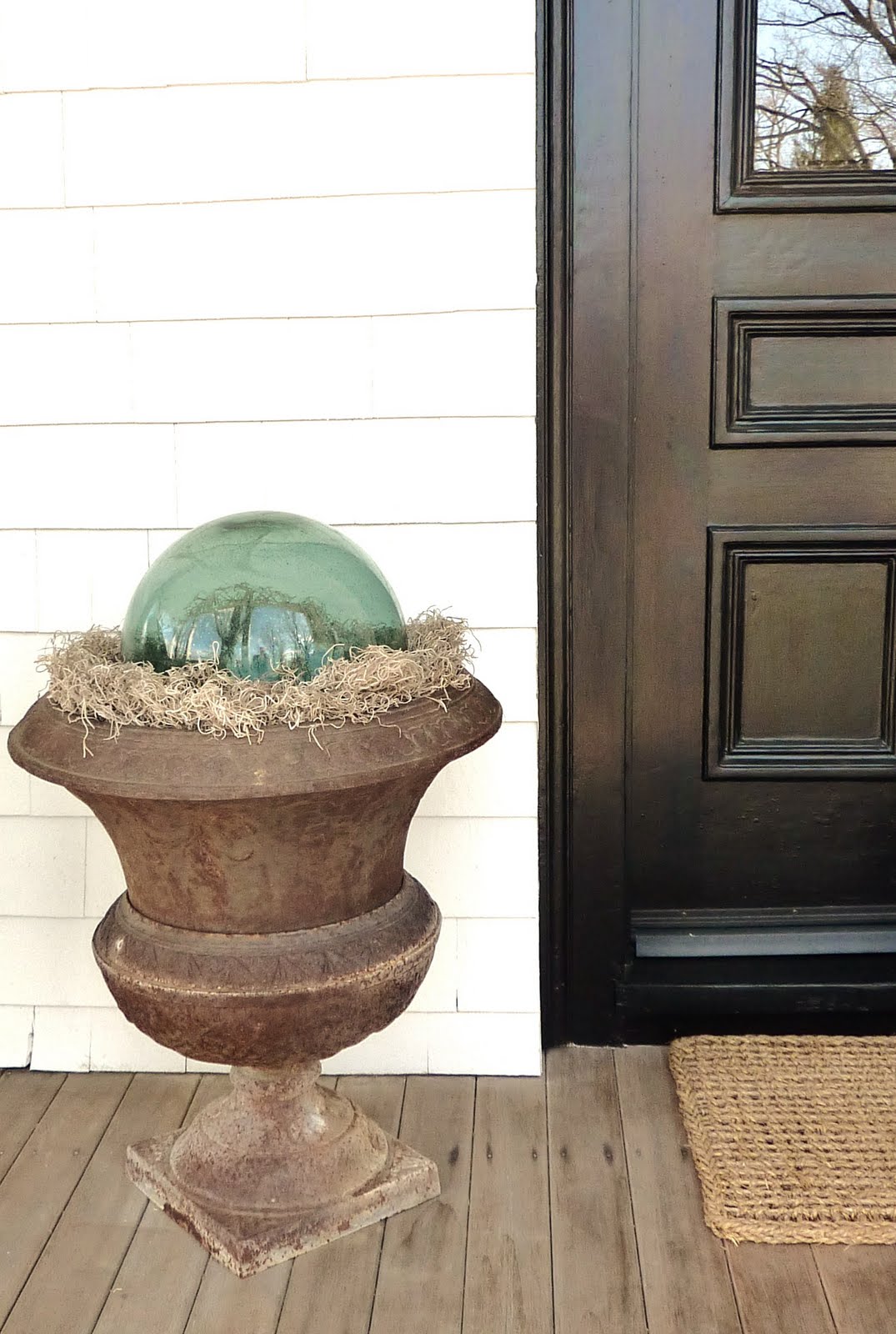
basketball-size fishing float in antique urn at front door


(This post could also be entitled "it's a small world," but I'll get to that story later in this post!)


Japanese glass fishing floats were once used by fishermen in many parts of the world to keep their nets afloat. Large groups of fishnets strung together, sometimes 50 miles (80 km) long, were set adrift in the ocean and supported near the surface by hollow glass balls or cylinders containing air to give them buoyancy.  These glass floats are no longer being used by fishermen, but many of them are still afloat in the world's oceans, primarily the Pacific.
The earliest floats, including most Japanese glass fishing floats, were hand made by a glassblower. Recycled glass, especially old sake bottles, was typically used and air bubbles in the glass are a result of the rapid recycling process. After being blown, floats were removed from the blowpipe and sealed with a 'button' of melted glass before being placed in a cooling oven. (This sealing button is sometimes mistakenly identified as a pontil mark. However, no pontil (or punty) was used in the process of blowing glass floats.) While floats were still hot and soft, marks were often embossed on or near the sealing button to identify the float for trademark. These marks sometimes included kanji symbols. Today most of the glass floats remaining in the ocean are stuck in a circular pattern of ocean currents in the North Pacific.   Once a float lands on a beach, it may roll in the surf and become "etched" by sand. Many glass floats show distinctive wear patters from the corrosive forces of sand, sun, and salt water. When old netting breaks off of a float, its pattern often remains on the surface of the glass where the glass was protected under the netting. Other floats have small amounts of water trapped inside of them. This water apparently enters the floats through microscopic imperfections in the glass while the floats are suspended in Arctic ice or held under water by netting.  Most floats are shades of green because that is the color of glass from recycled sake bottles (especially after long exposure to sunlight). However, clear, amber, aquamarine, amethyst, blue and other colors were also produced.
They have become a popular collectors’ item for beachcombers and decorators. Replicas are also being manufactured.
(The above excerpt is from Wikipedia and the full article can be read here.)


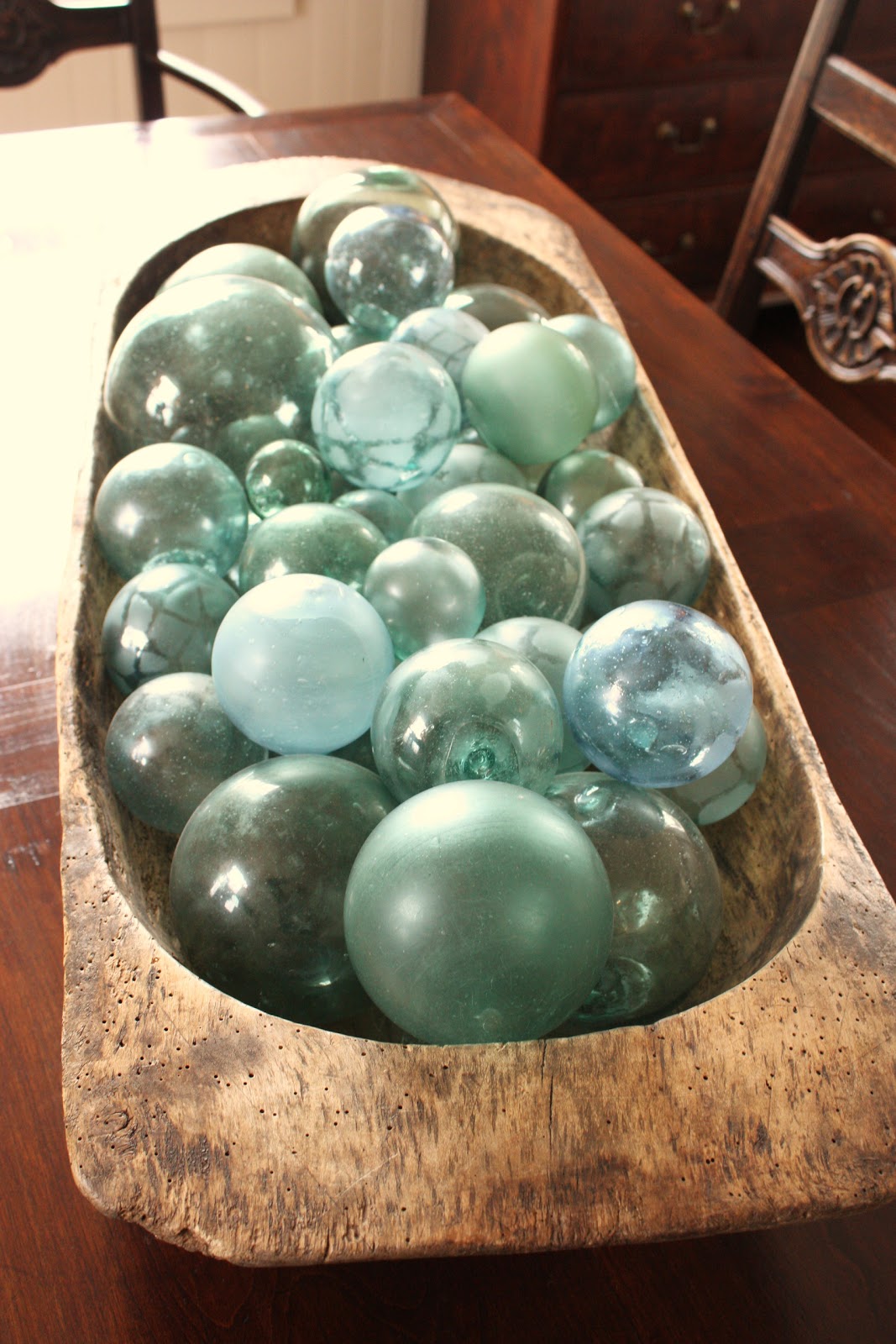
Fishing floats on the dining room table.  I love them all, but my very favorites have the rope etching.
photo for the love of a house


A collection of baseball-size floats still in their nets.
Vintage Biltmore Hotel Silver tray.
photo for the love of a house


Close-up of the "marking" on the float.
photo for the love of a house


More of the collection in the basement!  This jardiniere is huge, so the size of the floats is a little misleading..... the largest in this photo are basketball-size and the smallest is grapefruit-size!
photo for the love of a house


My own personal exposure to fishing floats came at a very young age...  as I've mentioned before, my mother grew up in Hawaii (the story of her childhood lamp that now resides in my kitchen is here) and she would find floats on the beach that had washed ashore.   When she married my father and moved to the mainland she brought those floats with her and I grew up in San Antonio with the floats scattered in the yard amidst the flowers and shrubs.  After meeting Dan and moving to the Pacific Northwest we began antiquing to furnish our then apartment.  I started spying the small floats at shops, back then for very little money- usually around $1-$3 each!!  The floats captured my heart for three reasons:  I have a fondness for the orb shape (as can be seen throughout the house); they reminded me of home; and being poor newlyweds,  at $1 it was sometimes the only thing I could afford to buy on a shopping trip!   
Thus, a collection began!!

Fast forward several years and many floats - small baseball-size floats, grapefruit-size and large basketball-size floats have now been added to our collection!  We lived in Dallas at this point, and my much;) older sister, Susan, and beloved brother-in-law, Doug, admired our collection and started collecting floats themselves.
We had many wonderful antiquing sources in the Northwest, so for my antiques business in Dallas Dan and I would fly back regularly to shop.  On one such trip we took Susan and Doug with us, and went to the Tacoma Dome Antiques Show.  At the show, we separated to shop and when we met back up with Susan and Doug they were in a booth that had floats for sale talking to a man who was introduced to us as "Frank Forster."  Frank evidently had a vast collection of floats and the next thing I know we are driving to Frank's house in Tacoma to see his collection!  And vast it was- Frank was a serious collector and a whole room had been dedicated to fishing floats!   We also met his lovely wife Kim.  My sister corresponded with Frank and Kim for several years, until Frank's death.

So..... imagine my surprise when several months ago while blog-hopping I stumble on a blog called
and on her site find photos and a mention of Frank and Kim's collection!! 
It is definitely a small world, yes?!
Rich Richardson and Frank Forster
photo Glass Float Junkie


Kamichia used to live in Alaska (she now lives on the Oregon coast) and would take plane trips to remote
beaches and find the likes of this....
photo by Glass Float Junkie

I squealed out loud when I first saw this photo!  The mother load of fishing floats right on the beach!!  Like an Easter egg hunt, only better!!!!  Can you imagine?! 
For a fascinating pictorial be sure to click on all of Kamichia's photo-links on her sidebar here showing her beach combing trips and the individual photos of different types of floats!

Since floats are now considered "collectibles", there are a lot of fakes out there too.  Kamichia talks about how to tell what is real from what is fake here.

Several of you have asked me where you might find fishing floats for sale; Kamichia also sells fishing floats on etsy,  (you can also look on ebay), but-  be forewarned.....
fishing floats can quickly become an obsession!!!:)


Here are a few other photos of how I use the vintage fishing floats around the house...
placed in the center of the iron dining table on the back porch


...in a copper tub filled with fishing floats and copper floats on the back porch


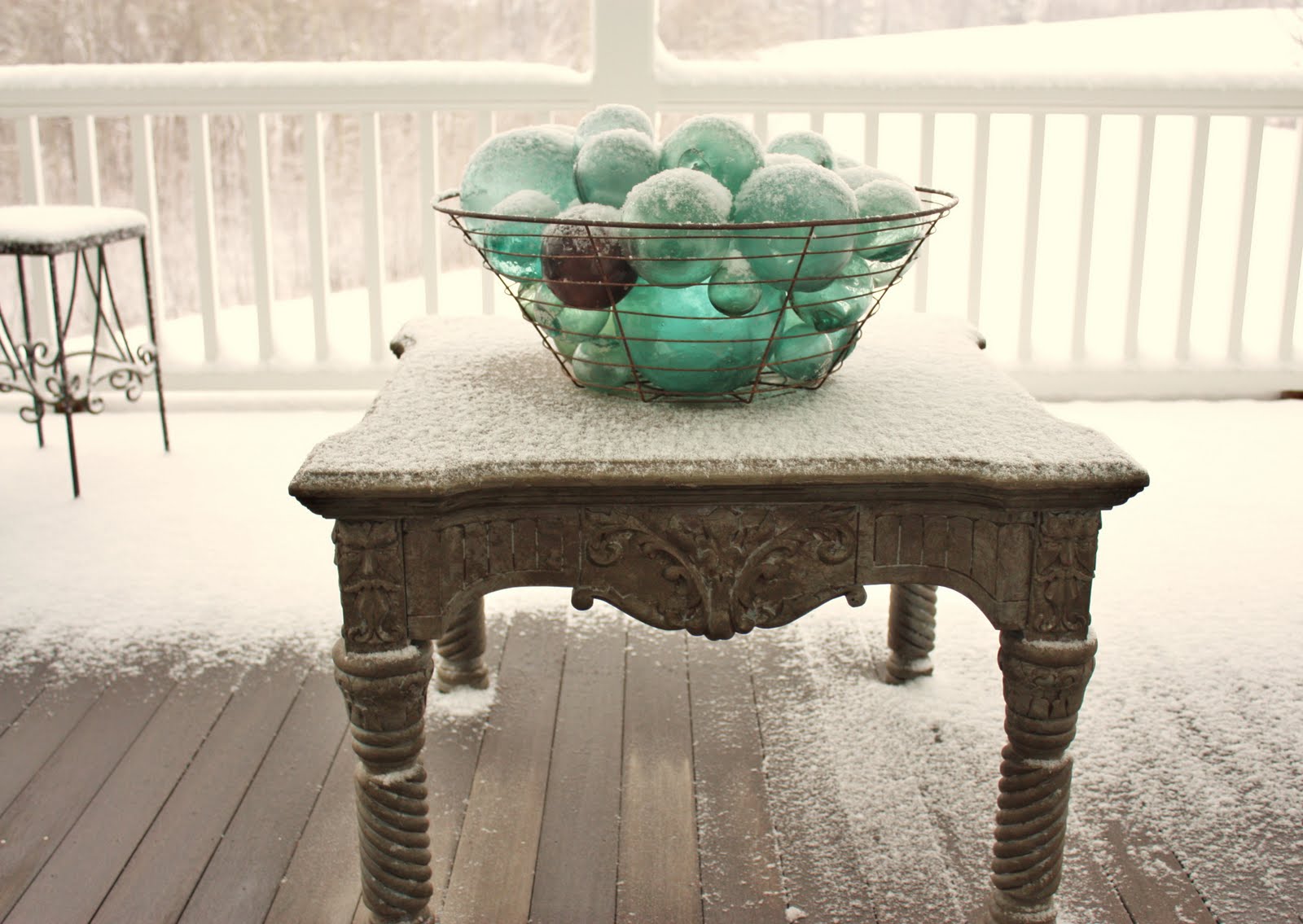
... in an old wire basket on the upstairs master bedroom porch.  I love the pop of color of the one amethyst float!


Monday, November 15, 2010

"An entryway is an introduction...."


"An entryway is an introduction.
Like the opening pages of a book, it leads us in and welcomes us to the world inside."
~Rose Tarlow~


Welcome to our world inside!
Come in, won't you?!!


Large dried gourd in an antique urn mixed with gourds and pumpkins at the front door; wicker basket holds shoes, rain boots, dog toys and towels for wet puppy feet!


The newel post was a tired, stained wood when we bought the house. I had it painted a gloss black to make it pop, and to make the statement that this is the entry! This is the same gloss black paint as the front door.
Antique chest holds: antique mirror with vintage oil painting leaning against it; antique wooden pediment fragment that serves as candle holder; vintage hotel silver tray that holds orchid and assortment of car keys, sunglasses and letters waiting to be mailed; lamp with linen shade was originally a vintage iron "smoking stand" which Dan turned into a lamp- the matchbox-holder from the stand is now the lamp's finial.
Antique French urn sitting on the floor holds ivy.
Collection of antique tortoiseshell frame mirrors on wall.
All of the walls in the farmhouse are plaster and are painted shades of gray.


Photo taken from the living room.
If you were to stand at the front door facing the base of the stairs and you turned right, that is the Dining Room (you can see a chair in this photo), if you turn left that is the Living Room. If you were to walk past the entry chest and turn to the left (behind the living room) that is the Reading Room. If you go past the entry chest and turn to the right (under the staircase) this will take you into the Kitchen. The stairs will take you up to the bedrooms.


View of the front door coming down the stairs.
Vintage alabaster chandelier was found at the Paris Flea Market at Porte de Clignancourt.
Antique rug.


Close-up of antique tortoiseshell frame mirrors. The top two we found at the Paris Flea Market. The top frame has a story that is worthy of it's own post! The bottom tortoiseshell framed mirror was found in Jackson, Mississippi.


Afternoon sunlight on the entry chest.


150 year old treads.... I love the wear.


Thank you for coming in!
I hope you'll come visit again.

Wednesday, March 3, 2010

hotel silver champagne buckets and more!

Hotel silver champagne buckets are difficult to come by. It was years after we first started collecting hotel silver before we even crossed paths with one, and then it was so ridiculously expensive we thought we’d never own one. But, as collecting goes we did find one, and then another and another…..!


This 1913 Biltmore hotel bucket is my favorite in our collection: from it’s time-worn monogram barely visible, to the drip-tray, to the handle, to the bun feet- I love everything about it! Found this gem on eBay years ago, and paid only $35, as he was listed in an unusual category (not “hotel silver.”) It has chilled champagne for us on many happy occasions!


This built-in cupboard in our dining room houses some of our larger hotel silver and antique ironstone pieces.


Another hard-to-find piece is this large punch bowl/ice bucket. I have only seen one other bowl this size in 15 years, and it was in a magazine!


A closeup of the above bowl. It is from the

Hotel Fontenelle and measures 15 inches handle to handle.


I’m especially fond of hotel silver trays, as I find lots of uses for them around the house:


You remember this large 1913 Biltmore Hotel tray on the kitchen dining table...


Here is it’s matching mate on the kitchen island holding a wire basket we found in France that is filled with topiaries.


Hotel tray from the Arizona Biltmore holds keys and sunglasses on the Entry chest-of-drawers.


Hotel tray from the Olympic Hotel on a skirted table in the Living Room.


Pierced hotel piece (The Commodore Hotel circa 1917) holds old photographs and an antique English horn and sterling magnifying glass in the Reading Room.


I'm a huge fan of actually using your collections, and I love the warm patina of the hotel silver placed throughout the house!